If there is one component in the air brake system that quietly plays a critical safety role, it is the Tractor Protection Valve (TPV). You can think of it as a built-in safety device that protects the tractor’s air supply in emergency situations.
Under normal operating conditions, drivers rarely notice it working. However, if a trailer develops a major air leak or becomes disconnected from the tractor, the tractor protection valve immediately activates. When this happens, the valve quickly stops the flow of air from the tractor to the trailer. This action serves two very important purposes: it preserves enough air pressure in the tractor so the driver can still apply the brakes, and it automatically causes the trailer’s emergency brakes to engage.
Understanding the Tractor Protection Valve
The tractor protection valve acts as an important safeguard within the air brake system. During normal operation, it allows compressed air to pass from the tractor into the trailer system, keeping the trailer brakes released and ready for normal braking when the driver applies the pedal. Its main function, however, is to protect the tractor’s air supply when something goes wrong.
This device is not a recent innovation. It has been a standard safety component in commercial vehicles for many years and is required to ensure safe operation of combination vehicles. Because of its importance, understanding how the tractor protection valve works is a key concept for both the CDL general knowledge exam and safe real-world truck operation.
The Three Main Functions of the Tractor Protection Valve
In situations where there is a sudden loss of air pressure in the trailer system, the tractor protection valve performs several critical functions almost instantly. Each of these actions is designed to help the driver maintain control of the vehicle and bring it to a safe stop.
To better understand its role, let’s examine the three primary functions of the tractor protection valve.
The Three Core Jobs of a Tractor Protection Valve
| Primary Role | What It Does | Why It Matters |
|---|---|---|
| Protect Tractor Air | It snaps shut, sealing off the tractor’s air reservoirs from the compromised trailer lines. | This ensures you have enough air pressure remaining to use your tractor’s own service brakes. |
| Apply Trailer Brakes | By cutting the air supply, it causes the powerful trailer spring brakes to engage automatically. | The trailer immediately begins to slow itself down, preventing a dangerous runaway situation. |
| Permit Manual Control | It remains connected to your cab controls, specifically the hand valve (or “trolley brake”). | You can still manually apply the trailer brakes if the situation allows, giving you more control. |
This quick-reference table sums up how the TPV keeps you safe during an air system failure.
To really get the full picture of the systems on a rig, it’s helpful to know about related components. For instance, while air systems are our focus here, many heavy-duty machines rely on a hydraulic power unit as the workhorse for other functions.
A TPV is your last line of defense. When it activates, it means the system has detected a catastrophic failure. Its ability to isolate the tractor from the trailer is what gives you the chance to bring the vehicle to a controlled stop, preventing a far worse outcome.
How the Tractor Protection Valve Works Under Pressure
To really get what a tractor protection valve does, you have to look at it in action during different situations. On a normal, uneventful drive, its job is pretty boring. It just acts like an open gate, letting compressed air flow from the tractor back to the trailer. This keeps the trailer’s big spring brakes held back, or “caged,” so the trailer can roll along without dragging.
But the TPV isn’t really there for the good days. It’s a guardian, a fail-safe that kicks in when things go wrong. Its entire reason for being is to react to a loss of air pressure, whether it’s sudden and violent or a slow, sneaky leak.
Reacting to Sudden Air Loss
Let’s start with the nightmare scenario: a trailer breakaway. The instant those gladhands rip apart, all the air in the trailer supply line escapes with a massive whoosh. That catastrophic drop in pressure is the TPV’s cue to spring into action.
Inside the valve, a plunger is held open by normal air pressure. The second that pressure vanishes, the plunger slams shut. It’s a purely mechanical reaction, and it does two things at once:
- It seals off the tractor’s air system, stopping your truck’s air tanks from bleeding out through the broken line.
- It cuts off the air supply to the trailer, which instantly causes the trailer’s powerful spring brakes to engage at full force.
This all happens in a blink of an eye. Since it’s all springs and air pressure, there’s no delay waiting for an electrical signal.
This diagram breaks down the TPV’s three core jobs in an emergency.
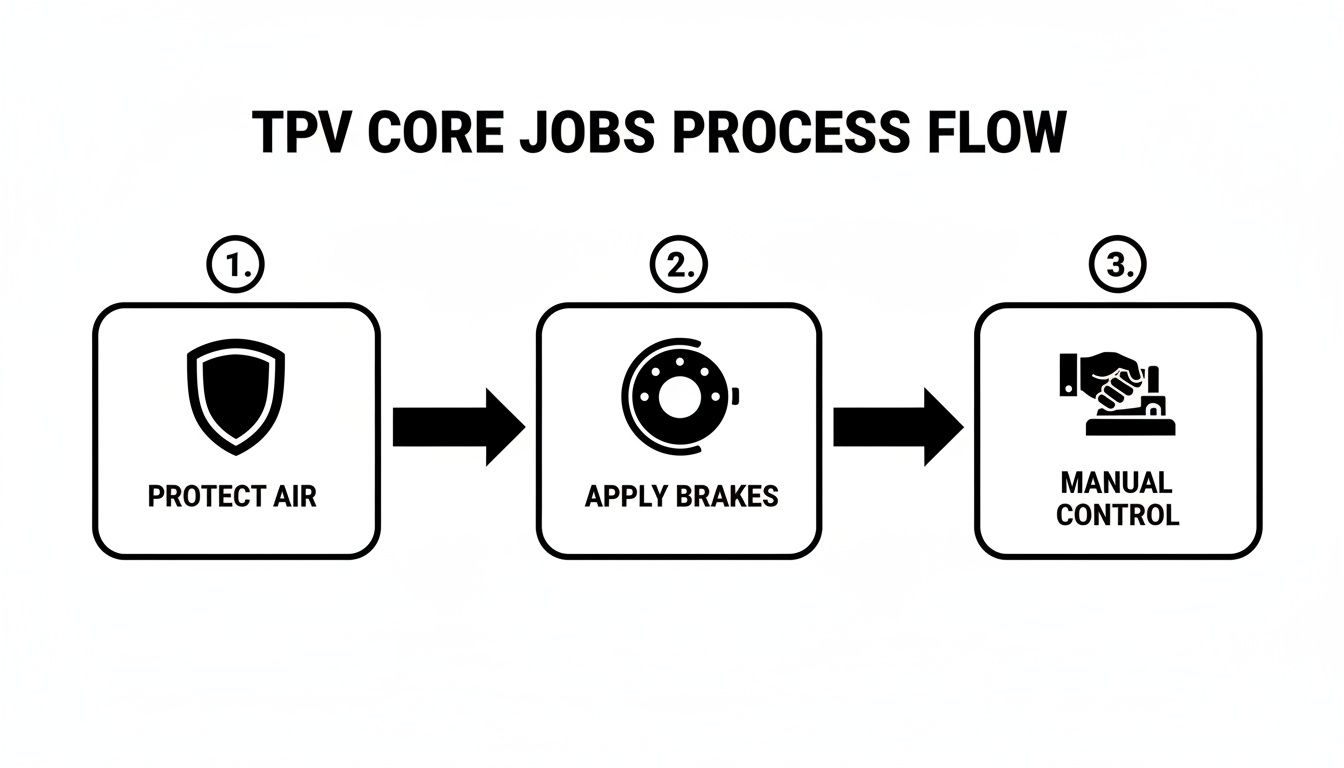
As you can see, it’s a simple, logical sequence: protect the tractor’s air, slam on the trailer brakes, and still allow the driver to have manual control.
Responding to a Gradual Leak
A breakaway is dramatic, but a slow leak can be just as dangerous. The TPV is designed to handle this, too. Imagine a tiny crack in an air hose that causes the system pressure to drop little by little. The valve is constantly monitoring this.
While a complete separation triggers an instant response, a gradual leak has a different trigger point. As the system pressure bleeds off, it will eventually hit a critical low, usually somewhere between 20 and 45 psi. At that point, there just isn’t enough air pressure left to hold the TPV’s internal mechanism open.
The moment the pressure falls below that preset minimum, the spring inside the TPV is finally stronger than the air pushing against it. This forces the red trailer air supply knob on your dash to pop out, giving you a clear physical and audible warning that your air is dangerously low.
This action closes the TPV, again isolating the tractor’s air and applying the trailer’s emergency brakes. Knowing this sequence is absolutely critical for your CDL test. If you want to see how these concepts pop up on the exam, check out some questions from an air brakes practice test.
Once that knob pops, you won’t be able to push it back in until the system builds its air pressure back up to a safe level. It’s a safety lockout, preventing you from trying to charge a system that it knows has a serious leak.
Getting to Know the Controls in Your Cab
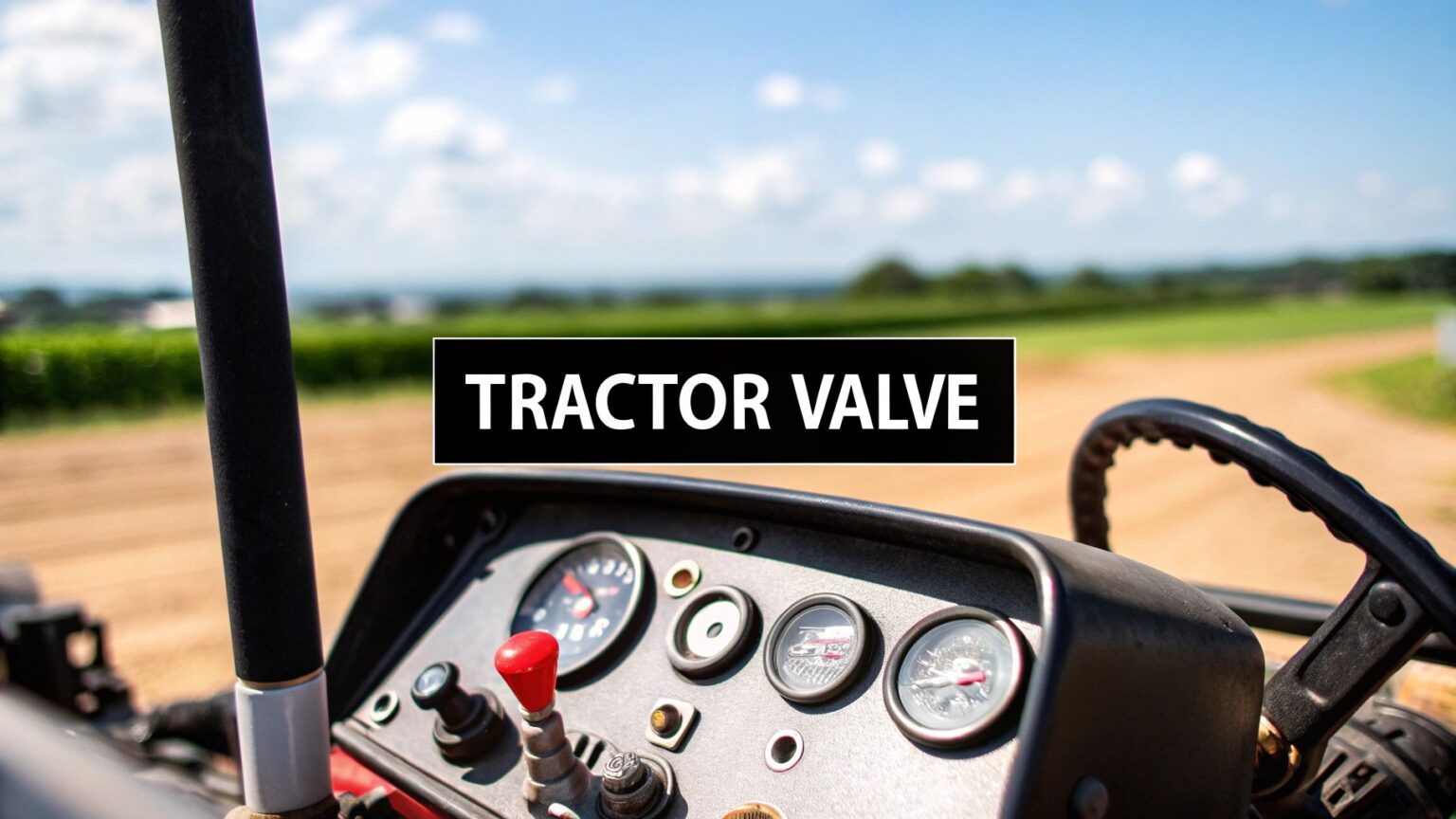
The tractor protection valve isn’t just some hidden part; it’s the heart of a system you control directly from the driver’s seat. To really understand how it works, and to ace your CDL exam, you need to be familiar with the knobs and levers on your dashboard. Think of them as your command center.
These controls are how you tell the tractor protection system what to do—either send air back to the trailer or hold it in the tractor. During your pre-trip inspection, you’re not just looking to see if they’re there; you have to know exactly what each one does. Examiners love to quiz you on this, so let’s break it down.
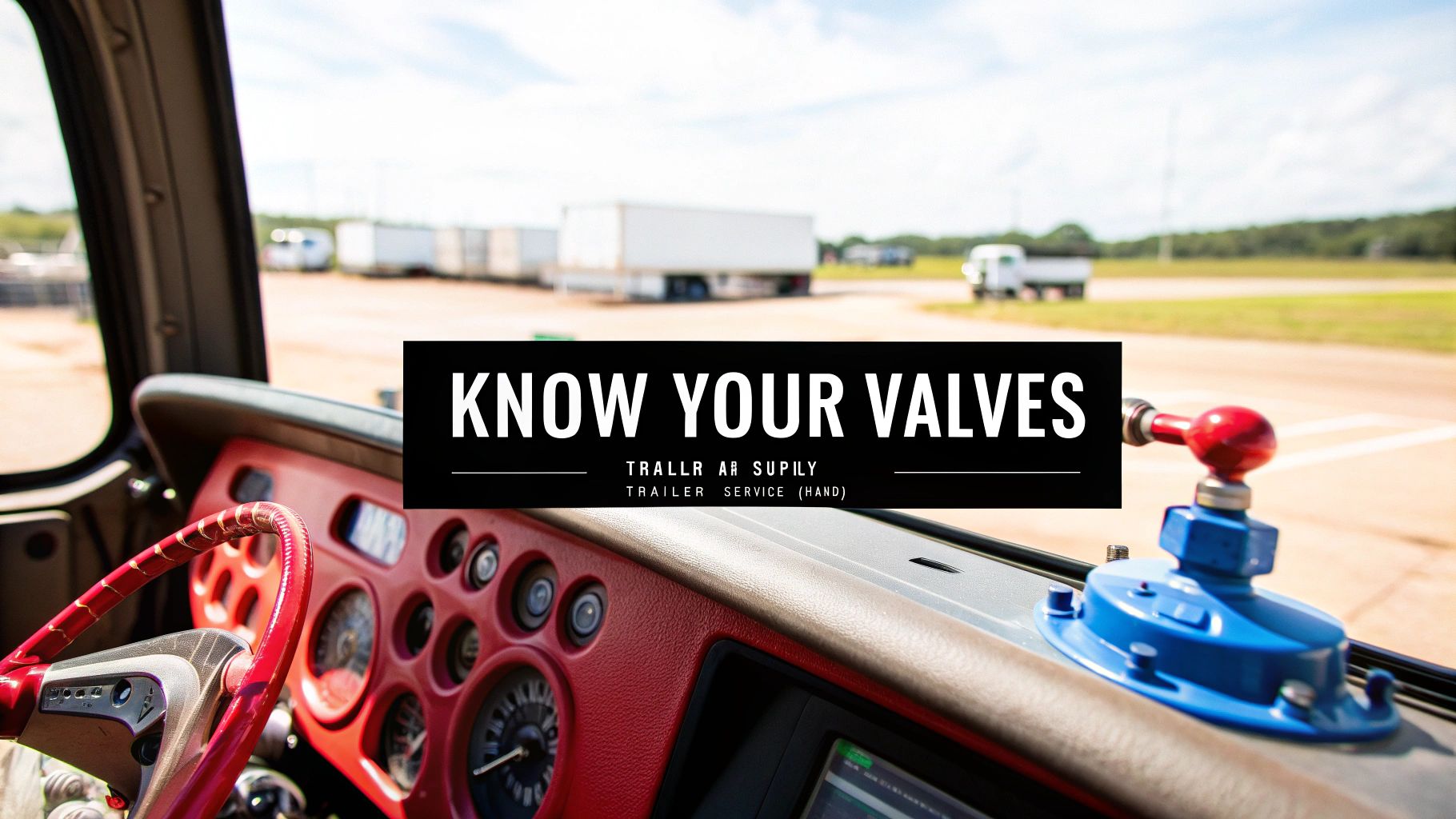
The Trailer Air Supply Valve
The first and most important control is the Trailer Air Supply valve. You can’t miss it—it’s the red, eight-sided button on the dash. Its job is simple but critical: it’s the main switch that sends air to your trailer.
- Pushed In: When you push this red knob in, you’re opening the gate. Air flows from the tractor to the trailer, filling its tanks and releasing the powerful spring brakes so you can roll.
- Pulled Out: Pulling the knob out does the opposite. It slams the gate shut, cutting off the air supply. This immediately triggers the trailer’s spring brakes, locking it down. This is how you set the trailer parking brakes.
This valve is also your first warning of a serious air leak. If your system pressure plummets (usually somewhere between 20-45 psi), this red knob will pop out all by itself. That’s the tractor protection valve saving the day by keeping the remaining air for the tractor’s brakes.
The Trailer Service Brake Valve
Right next to the red knob, you’ll often find a blue lever or button. This is the Trailer Service Brake valve, but you’ll hear most drivers call it the “trolley brake” or the “hand valve.” It has a totally different job from its red neighbor.
This hand valve lets you apply the trailer’s service brakes without touching the tractor’s brakes. While the foot pedal applies brakes to the whole rig, the hand valve isolates the trailer. It’s perfect for testing your gladhand connection during a pre-trip or for gently straightening out the trailer if you feel a jackknife starting.
Remember, keeping your rig safe means using quality components. When it’s time for repairs, always source reliable aftermarket heavy equipment parts to ensure everything works as it should. And if you want to get a head start on your exam, working through an air brakes test guide is a great way to practice the kind of questions you’ll see.
Why a Working TPV Is Your Last Line of Defense
Let’s move past the diagrams and technical jargon for a minute. The tractor protection valve isn’t just another part to memorize for your CDL exam; it’s the one component that can single-handedly prevent a bad day from becoming a catastrophic one. Think of it as your last line of defense on the road.
Imagine you’re rolling down the interstate and, without warning, a trailer air line bursts. Without a working TPV, your tractor’s air supply would bleed out in seconds. You’d lose your service brakes, turning a heavy rig into a runaway train. The TPV is what slams the door shut on that air loss, preserving the tractor’s air so you can keep control and bring the vehicle to a safe stop.
Preventing a Jackknife Scenario
Every trucker’s worst nightmare is a jackknife, where the trailer pivots and folds in towards the cab during a hard stop. It happens when the trailer brakes lock up and the tractor’s don’t, turning the whole rig into an unpredictable mess. The TPV is a crucial safeguard against this exact scenario.
If a trailer ever breaks away completely, the TPV instantly triggers the trailer’s emergency brakes. This action ensures the trailer starts slowing down on its own, instead of becoming an unguided missile. Those precious seconds give you the breathing room to manage the tractor and maintain control when everything else has gone wrong.
A functioning TPV is the dividing line between a manageable incident and an uncontrollable disaster. It ensures that even if you lose the trailer, you don’t lose the ability to stop the tractor. This component protects you, your cargo, and everyone else on the road.
Safety Backed by Data
This isn’t just theory; the numbers back it up. NHTSA stability tests revealed that TPVs, when working with electronic controls, boosted stability by a massive 25-40% during rollover prevention maneuvers. On a global scale, industry standards show that TPVs successfully prevent critical air loss in 95% of gladhand separations.
For anyone studying for their CDL, this is must-know information. A solid grasp of the TPV and the entire air brake system is essential for passing your exam, as a surprising number of students fail on these very questions. To see where you stand, you can test your knowledge with practice questions about combination vehicles and their systems. This isn’t just about passing a test; it’s the foundational knowledge that separates a rookie from a true professional who puts safety first.
Inspecting and Troubleshooting Your TPV System
Knowing your equipment inside and out is the mark of a true professional. The tractor protection valve isn’t just another part on your checklist; it’s a critical safety system that deserves your full attention during every pre-trip inspection. A few simple, hands-on checks can tell you everything you need to know about whether your last line of defense is ready to perform.
Think of it this way: regular inspection is preventative medicine for your rig. By learning to spot the early warning signs of a problem, you can take action before a minor hiccup turns into a major on-road emergency.
A Step-by-Step Pre-Trip TPV Check
You absolutely can and should test your tractor protection system every single day. This straightforward routine confirms that the valve’s automatic pop-out feature is working and that your air lines are holding strong.
Here’s how you do it:
- Step 1: Chock Your Wheels. Safety first. Always secure the vehicle to prevent it from rolling.
- Step 2: Charge the System. Fire up the engine and let the air compressor do its job, building pressure until the governor cuts out (usually around 120-135 psi).
- Step 3: Push in the Valves. Make sure both the yellow Parking Brake knob and the red Trailer Air Supply knob are pushed in.
- Step 4: Shut Off the Engine. Kill the engine but keep the key turned to the “on” position. You’ll need to see your air gauges.
- Step 5: Bleed the Air. Firmly press and release the brake pedal several times to drop the air pressure in the system.
- Step 6: Watch and Listen. Now, pay close attention to your air gauges and your ears. When the pressure drops to somewhere between 20 and 45 psi, that red Trailer Air Supply knob should pop out on its own. You’ll hear a very distinct click as it happens.
This simple test is a non-negotiable part of any proper pre-trip inspection. It’s your proof that the TPV will protect you if things go wrong.
Common TPV Failure Symptoms and Solutions
Even with diligent daily checks, components can wear out. Knowing the symptoms of a failing TPV helps you diagnose a problem on the spot. For any CDL student, mastering this is crucial—brake system faults are a contributing factor in roughly 10% of all skills test failures.
When the tractor protection valve became standard by the 1980s, it was a massive leap forward for semi-trailer safety. Later NHTSA tests revealed just how big of a deal it was: a functional TPV could reduce maximum wheel lift by up to 30% during a hard brake, which is a night-and-day difference in stability when you need it most.
To help you troubleshoot, here’s a quick guide to what some common TPV issues might be telling you.
Common TPV Failure Symptoms and Solutions
This table is a great starting point for diagnosing potential TPV issues you might encounter during your inspections.
| Symptom | Potential Cause | What to Do |
|---|---|---|
| Air Leaks from the TPV Exhaust Port | The internal plunger or seals inside the valve are likely worn out. | This valve is not designed to be repaired. Report it immediately for replacement. |
| Trailer Air Supply Knob Won’t Stay In | You have a major air leak somewhere in the trailer’s brake system. | Do not drive the vehicle. Your first step is to find and fix that air leak. |
| Trailer Tanks Won’t Charge with Air | The TPV itself could be faulty, or there’s a blockage or leak in the supply line. | Start by checking the gladhand connections. If they are secure, the TPV is the next suspect. |
| The Knob Fails to Pop Out During Test | The internal spring mechanism in the TPV has probably broken or seized up. | This is an immediate out-of-service condition. The valve must be replaced. |
Getting familiar with these symptoms will make your pre-trip checks faster, more effective, and ultimately keep you and everyone else on the road safer.
Common Questions About the Tractor Protection Valve
Alright, we’ve covered a lot of ground, but it’s totally normal to still have a few questions rattling around. When you’re dealing with something as important as your air brakes, you want to be crystal clear on how everything works together out on the road.
Let’s walk through some of the most common questions students have about the tractor protection valve and its buddies in the air brake system. Think of this as a quick Q&A to lock in what you’ve learned.
What’s the Deal with the Red and Blue Gladhands?
You’ll see this every time you hook up to a trailer. The gladhands are your quick-connect air line fittings, and the colors aren’t just for show—they’re a universal code.
The red gladhand is your emergency line, also called the supply line. Its only job is to send a constant supply of air from your tractor back to the trailer’s air tanks. This air is what holds back the powerful spring brakes on the trailer, allowing you to roll. The tractor protection valve is the gatekeeper for this red line.
The blue gladhand, on the other hand, is the service line. It only gets air when you actually hit the brakes, either with your foot pedal or the hand valve. That puff of air tells the trailer brakes how hard to clamp down. While the TPV’s main focus is the red line, a problem there is what triggers it to protect the entire system.
Why Did the Trailer Air Supply Button Pop Out?
If you see that little red, octagonal button on your dash pop out, don’t panic. It’s not broken; it’s doing exactly what it was designed to do. That’s your tractor protection system kicking in.
This happens automatically when the air pressure in your tractor’s system gets dangerously low, usually somewhere between 20 and 45 psi.
When that knob pops, it’s the TPV’s way of yelling, “We have a major leak!” It immediately cuts off air to the trailer to save what’s left for the tractor’s brakes. At the same time, this action automatically applies the trailer’s emergency spring brakes to help bring you to a safe stop.
It’s a simple, mechanical fail-safe that gives you a very clear sign that you have a serious air loss.
Can I Just Push the Supply Button Back in After It Pops?
Nope. If you can push it right back in and it stays, your valve is probably bad. The system is designed to prevent you from re-supplying air to a trailer that has a massive leak.
That button has a safety lockout. It will refuse to stay in until your air compressor has built the system pressure back up to a safe level, which is typically above 60 psi. If that red knob pops out, your first and only job is to get pulled over safely, find the leak, and get it fixed. Don’t even think about pushing that valve in until you’ve solved the problem and your air tanks are back in the green.
Is the Hand Valve the Same as the Tractor Protection Valve?
That’s a common point of confusion, but they are two completely separate parts that just happen to work together.
- The Tractor Protection Valve (TPV) is your automatic bodyguard. It’s a safety valve back on the tractor that watches over your air supply and slams the trailer’s emergency brakes on if there’s a catastrophic leak.
- The Hand Valve, often called the “trolley brake,” is a manual lever inside the cab. It lets you apply the trailer’s service brakes all by themselves, without touching the tractor brakes.
Air for the hand valve has to pass through the TPV, but they serve totally different functions. The TPV is your automatic guardian angel, while the hand valve is a tool you use for things like checking your connection or preventing a jackknife in slick conditions.
At Patriot CDL, we believe that expert knowledge is the key to a safe and successful career on the road. Our hands-on training programs are designed to give you a deep understanding of every system on your rig, ensuring you’re not just ready for the test, but ready for the job. Learn more about launching your truck-driving career by visiting https://cdlcompass.com/blog/.