If you’re considering enrolling in a truck driving school, one of the first things you’ll probably want to know is the total cost of training. In general, CDL training programs can range from about $1,500 to more than $10,000, depending on the school and the type of program. Most well-established training programs that offer complete instruction typically fall somewhere in the $4,000 to $6,000 range.
However, the advertised tuition price is only part of the overall cost. Think of it as the base price for getting started. Just like owning a truck requires additional expenses such as fuel, registration, and insurance, obtaining your CDL also involves several additional fees beyond the main training cost.
Understanding the Full Cost of CDL Training
When comparing schools, you’ll likely notice that prices vary significantly. This is because different types of programs offer different training structures. For example, a community college CDL course may take longer but cost less, while a private training academy may offer accelerated programs designed to get students licensed quickly. Although both options can lead to a CDL, the schedule, training style, and overall price can differ greatly.
To plan properly, it’s important to understand what contributes to the total cost. Tuition is usually the largest expense, but it is not the only one. Several additional costs are required in order to complete the licensing process and legally obtain a Commercial Driver’s License (CDL).
A Full Breakdown of CDL School Expenses
Planning your budget for CDL training is similar to preparing for a long-distance trip. Tuition represents the primary expense, but there are several smaller costs that must also be considered along the way. These may include fees for permits, testing, medical certification, and other required documentation.
If you focus only on the main tuition price, these additional expenses can easily be overlooked. Understanding the full cost ahead of time will help you create a realistic plan and avoid unexpected financial surprises during the training process.
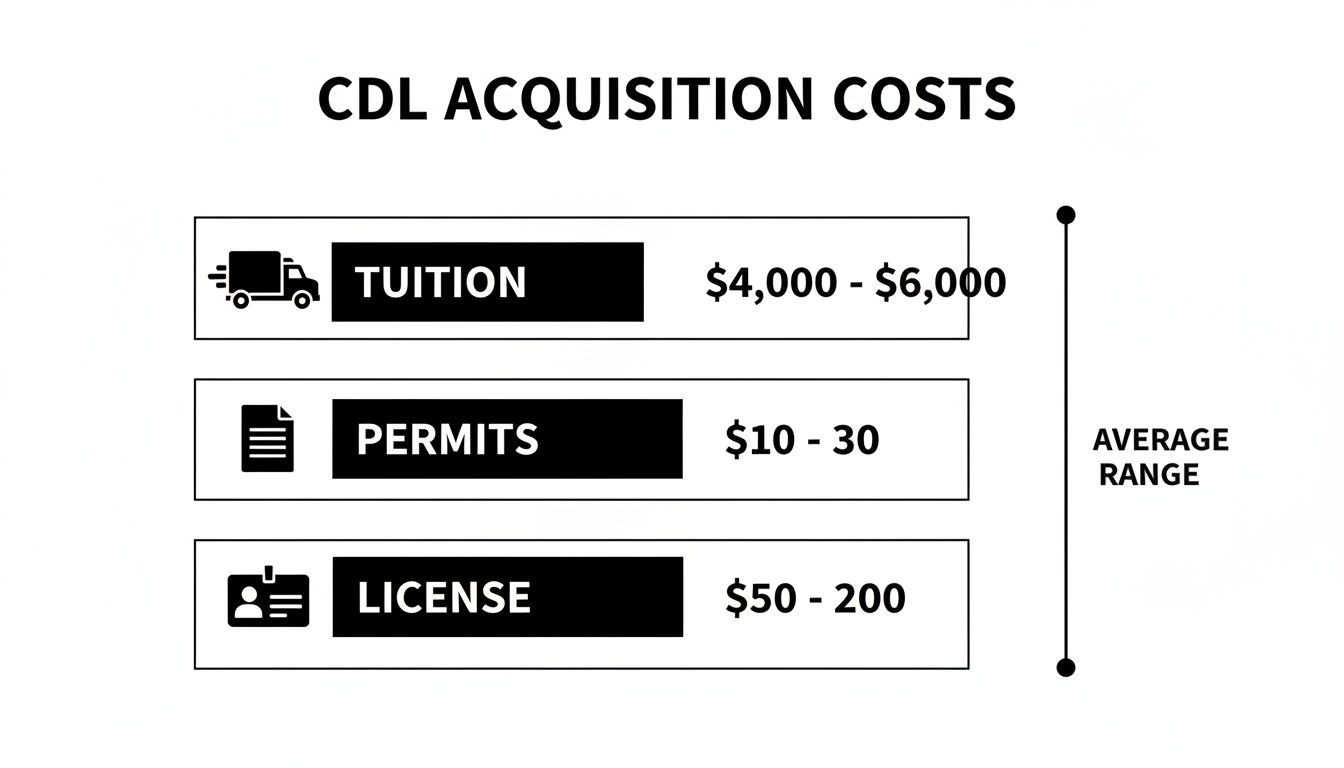
As you can see, those smaller fees aren’t optional. They are mandatory steps to getting licensed, so make sure they’re in your budget from day one.
To help you map out your expenses, here’s a table that lays out all the typical costs you can expect.
Estimated Truck Driving School Cost Breakdown
This table provides a quick summary of the typical costs associated with obtaining a CDL, from tuition to final licensing.
| Expense Category | Average Cost Range |
|---|---|
| Program Tuition | $3,000 – $8,000+ |
| DOT Physical Exam & Drug Test | $100 – $150 |
| Learner’s Permit (CLP) | $10 – $30 |
| CDL License Application Fee | $50 – $200 |
| Skills Test Fee | $100 – $300 |
| Endorsement Fees (Per Endorsement) | $25 – $50 |
This breakdown should help you anticipate every expense so there are no surprises holding you back.
Remember, the initial investment in a quality CDL program is directly tied to your future earning potential. A well-structured school prepares you not just to pass a test, but to succeed in a demanding and high-paying career from day one.
When you add it all up, getting a CDL is a significant financial step. Beyond the tuition, you have to budget for things like your temporary learner’s permit ($10 to $30) and the final CDL license fee, which can run from $50 to $200 depending on your state.
For more tips on how to prepare for this journey, you can explore more insights on our blog.
What Your Tuition Fee Actually Covers
When you first see the price tag for truck driving school—often several thousand dollars—it’s easy to feel a little sticker shock. It’s a big number, and a common question I hear is, “Where does all that money actually go?”
Think of it this way: you’re not just buying a single course. You’re investing in a complete career launchpad. Your tuition is a comprehensive package that bundles together everything you need to go from a total beginner to a licensed, road-ready professional.
The biggest chunk of that investment, and rightfully so, goes toward hands-on, behind-the-wheel instruction. We’re not talking about a quick spin around an empty parking lot. This is serious seat time in a full-sized rig, first on a dedicated training yard and then out on real public roads, with a seasoned instructor right there in the passenger seat guiding you.
Breaking Down the Core Components
That single tuition price covers the entire machinery of a professional training school. Beyond just your time in the truck, it funds everything needed to make your training possible.
Here’s a look at what’s typically baked into that price:
- Instructor Salaries: You’re paying for the deep knowledge of veteran drivers. These are the pros who know the industry inside and out and can teach you how to handle a big rig with safety and confidence.
- Vehicle and Equipment Use: This gives you access to the school’s fleet of semi-trucks and trailers for all your training, from learning basic backing maneuvers to mastering the skills for your final road test.
- Fuel and Maintenance: Keeping a fleet of commercial trucks running is a massive expense. They burn a lot of diesel and need constant, meticulous maintenance to stay safe. A good portion of your fee keeps those trucks fueled up and in top shape.
- Insurance Costs: This one’s huge. CDL schools have to carry hefty insurance policies to cover students, staff, and the equipment itself during training.
- Classroom Instruction: Long before you turn the key, you need to understand the rules of the road. Your tuition covers classroom time where you’ll learn federal regulations, safety protocols, how to manage your logbook, and everything else you need to know to pass the written exams.
Watch Out for Potential Hidden Fees
Now, while any reputable school will be upfront about their pricing, you still need to be a savvy consumer. Some expenses might not be rolled into that main tuition figure, so it’s critical to ask what’s not included to get the full picture.
A quality training program is an all-inclusive investment. The price reflects not just driving lessons, but access to professional-grade equipment, expert instruction, and the robust support system needed to launch a successful career.
Some of the most common costs that might be separate are:
- DOT Physical Exam and Drug Screening
- Textbooks and other training materials
- State fees for your permit application and final CDL skills test
- Additional fees for specific endorsements (like Hazmat or Tanker)
My best advice? Always ask for a complete, itemized cost breakdown before you sign anything. You can also learn more about transparent program pricing to see an example of a straightforward, all-in-one tuition structure. When you know exactly what’s covered, you can compare schools accurately and make a financial decision you feel good about.
Why Do CDL School Prices Vary So Much?
When you start shopping around for a CDL program, you’ll see the prices are all over the map. One school might quote you $3,000, while another just a few miles away is asking for $8,000. This isn’t just random pricing—there are very real reasons behind these numbers. Figuring them out is the key to picking a program that fits your wallet and your career goals.
Think of it like buying a car. You can get a basic, no-frills sedan that does the job, or you can opt for a fully-loaded truck with all the latest tech and a bigger engine. Both get you down the road, but the experience and capability are worlds apart, and the price reflects that. CDL schools are no different. The final cost is a direct reflection of the quality, depth, and resources packed into the training.
The biggest driver of cost is easily the length and depth of the program. A quick, accelerated course might have you ready for the test in just a couple of weeks by drilling you on the absolute essentials. On the other hand, a comprehensive program that runs for a month or more will give you significantly more time behind the wheel, cover advanced driving maneuvers, and provide deeper classroom instruction. That extra time and attention naturally comes with a higher price tag.
Location and Quality of Equipment
Where the school is physically located makes a big difference. A training facility in a major city has to contend with higher rent, pricier fuel, and more expensive insurance. Those costs inevitably get baked into your tuition. A school out in a more rural area often has lower overhead, which can translate into a more affordable program.
The trucks themselves are another huge piece of the puzzle. A school that invests in a modern, well-maintained fleet is giving you a safer and more realistic training experience that prepares you for the rigs you’ll actually be driving.
- Newer Fleet: Schools with up-to-date trucks have higher purchase and maintenance costs, which you’ll see in the tuition.
- Older Fleet: Programs that run on older, high-mileage trucks can offer a lower price, but you might not get familiar with the modern systems you’ll encounter on the job.
A school’s price often reflects its investment in your success. For example, a low student-to-instructor ratio is fantastic because you get more one-on-one coaching, but that premium service costs more to provide.
License Class and Endorsements
Finally, what you’re training for directly impacts the cost. Getting a Class A CDL, the license needed for tractor-trailers, is the most involved and intensive training, making it the most expensive option. A Class B CDL program for vehicles like straight trucks or buses is usually shorter and costs less.
On top of that, adding endorsements to your license will increase the total cost. If you want to haul hazardous materials (Hazmat), drive tanker trucks, or pull double/triple trailers, you’ll need specialized training and testing for each one. To get the full rundown on what each class involves, you can explore our guide on understanding CDL requirements.
All these variables are why it’s so important to look past the sticker price and ask what’s actually included.
Connecting Training Quality to Your Earning Potential
It’s easy to look at truck driving school as just another bill to pay, but that’s a classic rookie mistake. A much better way to think about it is as a direct investment in your future paycheck. A cheap, fast program might look good on paper, but a higher-quality, more thorough school is what really sets you up for a long, profitable career on the road.
The difference is night and day. Bare-bones “CDL mills” have one goal: to get you to pass the test, and that’s it. On the other hand, a top-tier professional academy prepares you to be a professional driver. You’ll get more hours behind the wheel, learn advanced defensive driving skills, and connect with reputable carriers who are actively looking for the best new talent.
The Long-Term Financial Impact
This difference in training quality shows up in your wallet almost immediately. A graduate from a comprehensive six-week professional program can expect to earn about $15,000 more in their very first year—pulling in around $70,000 versus $55,000 for someone who just scraped by at a CDL mill.
That’s a huge gap, and it only gets wider over time.
Let’s look at how that initial investment pays off over the first five years. A higher starting salary and better job prospects mean the professionally trained driver could earn a cumulative $400,000. The driver who took the shortcut? They’re looking at around $318,000. That extra tuition money you spent upfront can pay for itself many times over.
Here’s a clearer picture of how that plays out.
Training Quality vs. Career Earnings: A Five-Year Outlook
| Metric | Quick CDL Mill Program | Comprehensive Professional Program |
|---|---|---|
| Initial Training Cost | $3,000 – $5,000 | $6,000 – $10,000 |
| First-Year Salary | ~$55,000 | ~$70,000 |
| Five-Year Earnings | ~$318,000 | ~$400,000 |
| Career Access | Entry-level, lower-paying jobs | Premium carriers, better routes & pay |
| Skill Set | Basic test-passing skills | Advanced maneuvering, safety protocols |
| Return on Investment | Slower career growth, lower ceiling | Faster advancement, higher lifetime earnings |
The numbers don’t lie. The initial sticker price is only a tiny part of the story.
It’s also not just about driving. Quality schools prepare you for the real world of trucking, touching on topics like the evolving role of technology in trucking insurance and other business aspects you’ll need to know.
Why Better Training Attracts Better Companies
Let’s be honest: the best trucking companies know the difference. They can spot a driver who just learned to pass a test versus one who is truly road-ready. They actively recruit from reputable schools because those graduates are safer, more efficient, and don’t need their hands held.
Investing in a premium CDL program isn’t just about learning to drive a truck; it’s about gaining access to a higher tier of employment opportunities that offer better pay, superior benefits, and greater long-term job security.
Simply put, by choosing a better school, you are pre-qualifying yourself for better jobs right out of the gate. The question of how much does truck driving school cost is less about the upfront number and more about the lifetime value it brings to your career. An extra couple of thousand dollars now can unlock tens of thousands more in earnings in just your first few years alone.
Smart Ways to Fund Your CDL Training
Sticker shock is real, but don’t let the upfront cost of truck driving school steer you away from a great career. The reality is, a quality CDL education is much more affordable than most people think because there are so many ways to pay for it.
The trick is knowing where to look. Think of it like planning a road trip—some people pay cash for everything upfront, while others use company cards or find sponsored routes. There’s a path for just about every budget, and finding the right one lets you focus on the training, not the bill.
Company Sponsored Training and Tuition Reimbursement
This is probably the most direct route to getting on the road with zero out-of-pocket cost. With company-sponsored CDL training, a trucking company pays your entire tuition. What’s the catch? It’s really more of an agreement: you commit to driving for them for a set period, usually about a year. It’s a fantastic deal because you’re getting your training paid for and have a job waiting for you the day you graduate.
A close cousin to this is tuition reimbursement. In this scenario, you cover the school costs yourself, maybe with a loan or savings. Once you’re hired, your new employer pays you back for it, typically through monthly additions to your paycheck until the school bill is settled. This gives you the freedom to pick any school you like while still having your company foot the bill in the end.
Government Grants and Veteran Benefits
Don’t overlook government programs—they are a goldmine for career training. The Workforce Innovation and Opportunity Act (WIOA) is a federal grant specifically for helping people get the skills they need for in-demand jobs, and trucking definitely qualifies. If you’re eligible, WIOA can cover up to 100% of your CDL tuition. Best of all, it’s a grant, not a loan, so you never have to pay it back.
For those who have served in the military, the GI Bill® is a powerful and well-earned benefit. Many top-tier CDL schools are approved to accept these funds. This allows you to put the educational benefits you earned through your service toward your new career in trucking.
Finding the right funding is about matching your personal circumstances with the available options. Whether it’s a grant, a company sponsorship, or a flexible loan, there’s a practical solution to help you launch your new career.
Loans and School Payment Plans
If grants or sponsorships don’t quite fit your situation, financing is an extremely common and practical path. Lenders recognize the high demand for drivers, so they’ve created loan products specifically for career training like this.
Some programs even let you get started with a very small down payment—sometimes as low as $225—and finance the rest. Lenders like Sallie Mae, Ascent, and College Ave all offer career training loans that can get you into the driver’s seat.
Most schools also offer their own in-house payment plans. This is a simple and direct way to break up the tuition into smaller, more manageable chunks that you pay as you go through the program. To see what might work for you, you can contact our admissions team to discuss financing. All these different options mean the answer to how much does truck driving school cost is almost always “less than you think.”
Common Questions About Truck Driving School Costs

When you’re thinking about starting a new career in trucking, it’s only natural for money questions to be front and center. Getting straight answers is the first step to making a smart decision, so let’s tackle some of the most common questions we hear from people just like you.
Can I Get My CDL Training for Free?
Believe it or not, yes—getting your CDL training without paying out of pocket is a real possibility. The most popular way to do this is through company-sponsored training programs. A trucking company will pay for your school upfront, and in return, you agree to drive for them for a set amount of time, usually about one to two years.
Government grants are another fantastic option. Programs like the Workforce Innovation and Opportunity Act (WIOA) are designed to help people get into high-demand fields and can cover up to 100% of your tuition if you qualify. Just remember to read the fine print on any “free” training offer so you know exactly what’s expected of you.
How Quickly Will I Earn Back My Tuition?
This is one of the best parts about trucking: the return on your investment is incredibly fast. Most first-year drivers earn between $55,000 and $70,000. If your program costs between $4,000 and $6,000, you could easily earn that back within your first couple of months on the road.
Because qualified drivers are in such high demand, you can start seeing a positive return on your investment almost as soon as you have that license in your hand.
Think of your CDL training not as a cost, but as an investment in immediate earning power. The strong starting salaries in trucking mean you can recoup what you spent and start building your future faster than in almost any other field.
Once you’re out there earning, it’s smart to think about managing your money well. Learning what receipts to keep for tax deductions early on will make a big difference down the road.
Should I Pay Upfront or Finance My CDL School?
This really comes down to what works best for your own finances. If you have the savings, paying upfront is a fantastic way to start your career completely debt-free.
But let’s be realistic—most people don’t have that kind of cash just lying around. That’s why financing is such a common and practical choice. With a new driver’s salary, the loan payments are typically very manageable. Company sponsorship is another path where you essentially “pay” with your time and commitment, but it does mean you’re locked in with that one carrier for a while.
Are Cheaper Online CDL Programs a Good Idea?
Be very, very careful with programs that seem suspiciously cheap or promise a fully online CDL. While it’s fine to do the classroom theory portion online to fit your schedule, there’s absolutely no way to earn a CDL without hours of hands-on, behind-the-wheel training.
The most important—and expensive—part of your training has to happen in a real truck with a qualified instructor sitting next to you. A program that’s 100% online simply won’t meet the federal requirements to get you licensed. A good school blends book smarts with practical road skills, which is the same approach we take when helping students prepare for their CDL permit test.
Ready to invest in a career that offers real freedom and earning potential? At Patriot CDL, we offer accelerated, affordable training designed to get you on the road and earning, fast.